
 Wildlife
of Bolivia
Savanna Oncilla
Cats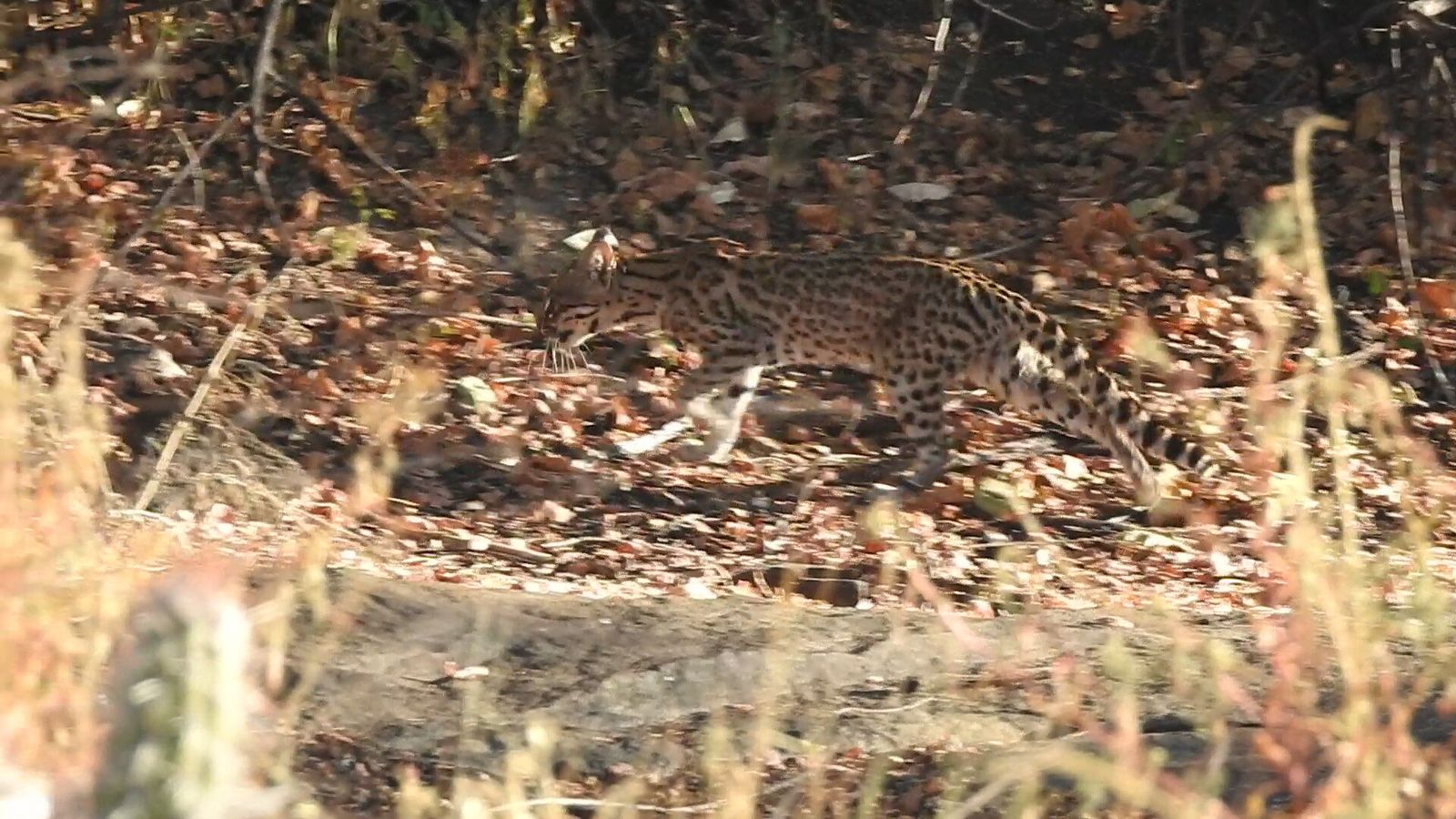
Photo: Adeilson Melo · CC BY 4.0
Leopardus tigrinus
Basic stats
Diet
Mainly small rodents, lizards, birds and insects; also tree frogs, shrews and opossums
Habitat
Varied forest and scrub, from semi-arid thorn scrub in north-east Brazil and dry Caatinga and Cerrado to subtropical forest and montane cloud forest up to about 3,000m
Range
From Central America (Costa Rica and Panama) through the Amazon basin to central Brazil
Litter size
One to three, most often one
Gestation period
74–76 days; about 75 days (AnAge)
Size
Body 38–59cm; tail 20–42cm
Weight
1.5–3kg; about 2.25kg on average (AnAge)
The oncilla is the smallest of the South American spotted cats (Handbook of the Mammals of the World). It resembles the margay and the ocelot but is smaller, with a slender build and a narrower muzzle (Wikipedia, general species account). Its thick, soft fur is light brown to dark ochre, with numerous dark rosettes across the back and flanks that are open in the centre and irregular in shape. The underside is whitish and heavily marked with dark spots, the tail is ringed, and the backs of the ears are black with a bold white spot (Handbook of the Mammals of the World; Wikipedia, general species account). Melanistic individuals are reported from the more heavily forested parts of its range (Wikipedia, general species account).
It is mainly nocturnal and usually seen alone, though in the Brazilian Caatinga, where diurnal lizards are a main food source, it is active by day (Wikipedia, general species account; Handbook of the Mammals of the World). It is primarily terrestrial but climbs well, and it stalks its prey before pouncing. Oestrus lasts three to nine days, and females have one to three kittens after a gestation of 74 to 76 days. The kittens' eyes open after 8 to 17 days and they start solid food at 38 to 56 days (Wikipedia, general species account). Sexual maturity comes at about two to two and a half years (Wikipedia, general species account). The species has been reassessed in recent years: a 2013 proposal split off the southern tiger cat, L. guttulus, and a 2024 study proposed the clouded tiger cat, L. pardinoides, as a further species. A 2026 analysis added the tilcayo, L. tilcayo (Wikipedia, general species account).
The species' listed South American range includes Bolivia (GBIF species profile), but the sources give no Bolivian localities or records for this species.
Quick answers
- What does the Savanna Oncilla eat?
- Mainly small rodents, lizards, birds and insects; also tree frogs, shrews and opossums
- What habitat does the Savanna Oncilla live in?
- Varied forest and scrub, from semi-arid thorn scrub in north-east Brazil and dry Caatinga and Cerrado to subtropical forest and montane cloud forest up to about 3,000m
- Where is the Savanna Oncilla found?
- From Central America (Costa Rica and Panama) through the Amazon basin to central Brazil
- What is the litter size of the Savanna Oncilla?
- One to three, most often one
- How long is the gestation period of the Savanna Oncilla?
- 74–76 days; about 75 days (AnAge)
- How big is the Savanna Oncilla?
- Body 38–59cm; tail 20–42cm
- How much does the Savanna Oncilla weigh?
- 1.5–3kg; about 2.25kg on average (AnAge)