 Wildlife
of Bolivia
Marsh Deer
Deer & Chevrotains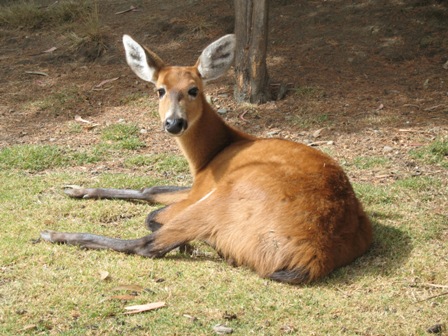
Photo: No machine-readable author provided. Exlbris assumed (based on copyright claims). · CC BY 2.5
Blastocerus dichotomus
Basic stats
Diet
Aquatic and semi-aquatic plants such as grasses, water hyacinth relatives, legumes and water lilies; shrubs and vines during floods
Habitat
Marshes, swamps and seasonally flooded grassland with standing water up to about 60–70cm deep; avoids forest
Range
South of the Amazon to northern Argentina; widely distributed in the Bolivian lowland wetlands
Litter size
Usually 1, occasionally twins
Gestation period
About 271 days
Size
Head and body 1.53–2m; 1–1.27m at the shoulder
Weight
Males 80–125kg (up to 150kg); females about 70kg
The marsh deer is the largest deer in South America. It has a long, shaggy, reddish-brown to bright chestnut coat, black lower legs and muzzle, a white ring around the eye, and very large ears lined with white hair. The bushy tail is rusty above and black below. Only males carry antlers, which reach about 60cm and usually have four or more points, the main beam forking near the base. The two toes of each hoof are long and joined by a stretchy membrane that can spread up to 10cm apart, spreading the deer's weight on soft mud and helping it swim (Wikipedia, general species account; Mammalian Species account).
Marsh deer live alone or in small groups of up to about six with a single adult male. They prefer standing water about 30–60cm deep and feed mostly on aquatic plants, switching to shrubs and vines when floods are high. They move with the water level between wet and dry seasons, and long floods can trap and starve animals on small islands. Fawns are born unspotted. Jaguar and puma are the main natural predators (Wikipedia, general species account; Mammalian Species account).
The species' Mammalian Species account described it as still widely distributed in Bolivia, though at low numbers, while elsewhere it is now reduced to isolated populations in the Paraná, Paraguay, Araguaia and Guaporé basins. Draining of marshes, dams, poaching for antlers and diseases caught from cattle are the main threats (Wikipedia, general species account). On this guide it is a target species of Barba Azul and the Beni savannas, Noel Kempff Mercado, the Bolivian Pantanal and the Jaguarland Reserve.
Quick answers
- What does the Marsh Deer eat?
- Aquatic and semi-aquatic plants such as grasses, water hyacinth relatives, legumes and water lilies; shrubs and vines during floods
- What habitat does the Marsh Deer live in?
- Marshes, swamps and seasonally flooded grassland with standing water up to about 60–70cm deep; avoids forest
- Where is the Marsh Deer found?
- South of the Amazon to northern Argentina; widely distributed in the Bolivian lowland wetlands
- What is the litter size of the Marsh Deer?
- Usually 1, occasionally twins
- How long is the gestation period of the Marsh Deer?
- About 271 days
- How big is the Marsh Deer?
- Head and body 1.53–2m; 1–1.27m at the shoulder
- How much does the Marsh Deer weigh?
- Males 80–125kg (up to 150kg); females about 70kg