
 Wildlife
of Bolivia
Margay
Cats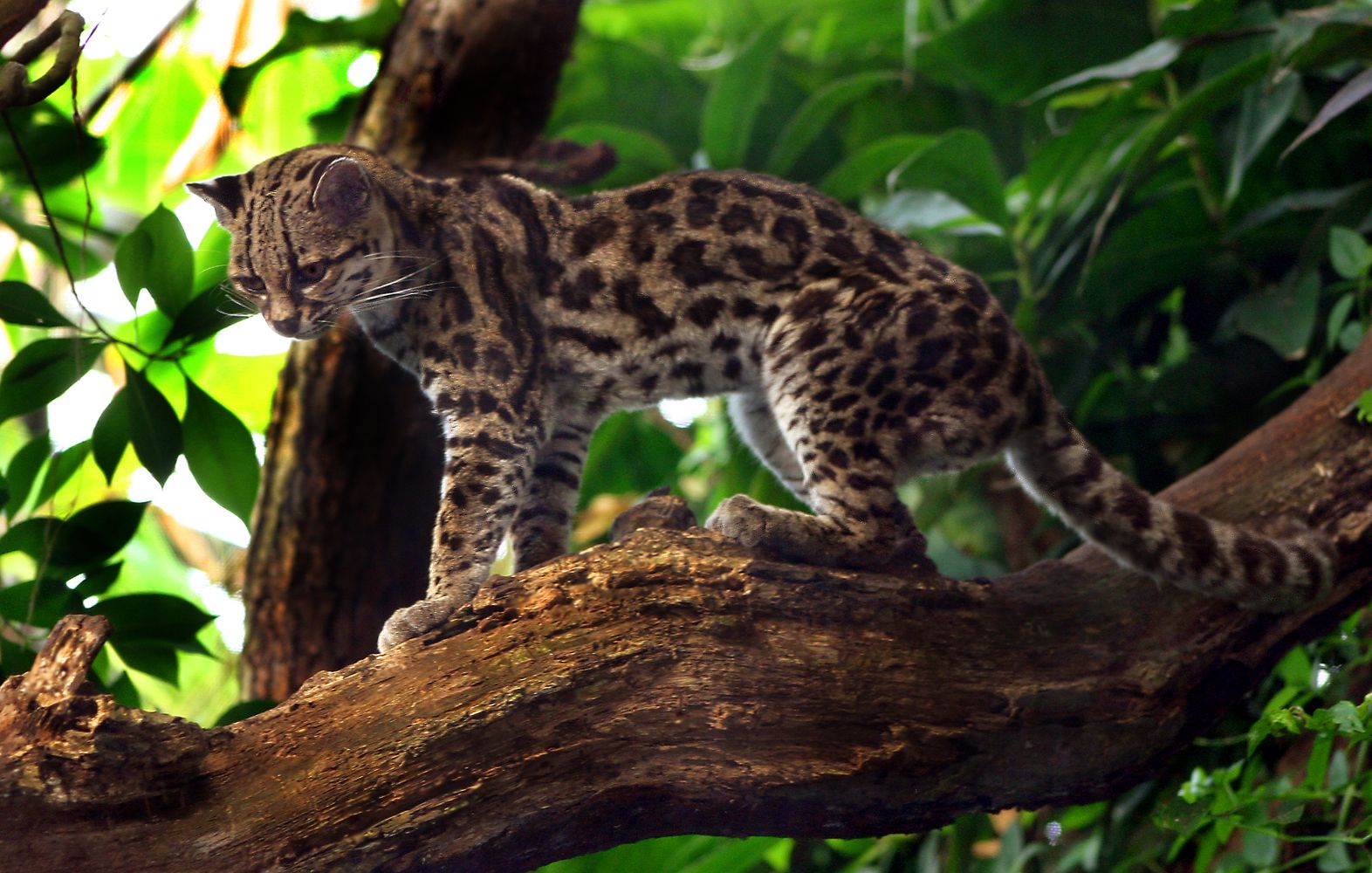
Photo: Malene Thyssen (User Malene ) · CC BY-SA 3.0
Leopardus wiedii
Basic stats
Diet
Small primates, birds, lizards and their eggs, small snakes, tree frogs and arthropods; occasionally ground prey such as agoutis and armadillos
Habitat
Almost exclusively dense forest, from tropical evergreen to tropical dry forest and high cloud forest; occasionally coffee and cocoa plantations
Range
Mexico, Central America and South America south to Paraguay, southern Brazil, northern Argentina and Uruguay
Litter size
Usually 1, very rarely 2
Gestation period
About 80 days
Size
Head and body 48–79cm; tail 33–51cm
Weight
2.6–4kg
The margay looks much like the larger ocelot, but its head is a little shorter, its eyes are larger, and its tail and legs are longer. Its brown coat has rows of dark brown or black rosettes and streaks, the underside is buff to white, and the tail has numerous dark bands and a black tip. The backs of the ears are black with a white centre (Wikipedia, general species account; Handbook of the Mammals of the World). It weighs 2.6–4kg, and the female has only two teats, which is unusual among cats (Wikipedia, general species account).
It is solitary and nocturnal and spends most of its time in trees, leaping after birds and monkeys through the canopy. Its ankles turn up to 180 degrees, its tail helps it balance, and it can jump up to about 3.7m horizontally (Wikipedia, general species account). Home ranges cover 11–16km², and it marks its territory with urine and scratch marks (Wikipedia, general species account). Females are in oestrus for four to ten days in a 32–36-day cycle, and gestation lasts about 80 days, usually producing a single kitten between March and June (Handbook of the Mammals of the World; Wikipedia). Kittens weigh 85–170g at birth. Much of what is known about breeding comes from a few captive animals (Handbook of the Mammals of the World).
Bolivia is within the margay's range. In Bolivia it has been reported in xerophytic thickets and in the Bolivian Chaco (Handbook of the Mammals of the World). These are drier settings than the dense, mostly evergreen forest the species favours elsewhere, and across its range the margay is more strongly tied to forest than any other Neotropical cat (Handbook of the Mammals of the World).
Quick answers
- What does the Margay eat?
- Small primates, birds, lizards and their eggs, small snakes, tree frogs and arthropods; occasionally ground prey such as agoutis and armadillos
- What habitat does the Margay live in?
- Almost exclusively dense forest, from tropical evergreen to tropical dry forest and high cloud forest; occasionally coffee and cocoa plantations
- Where is the Margay found?
- Mexico, Central America and South America south to Paraguay, southern Brazil, northern Argentina and Uruguay
- What is the litter size of the Margay?
- Usually 1, very rarely 2
- How long is the gestation period of the Margay?
- About 80 days
- How big is the Margay?
- Head and body 48–79cm; tail 33–51cm
- How much does the Margay weigh?
- 2.6–4kg