
 Wildlife
of Bolivia
Lowland Tapir
Elephants, Tapir & Rhinos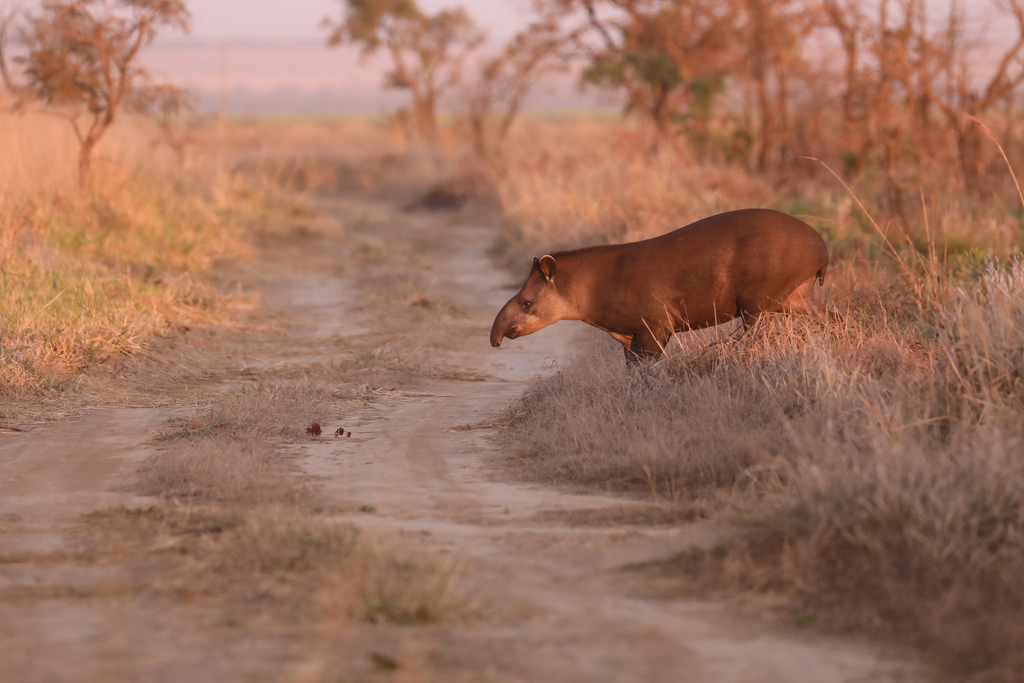
Photo: Terrasos · CC BY-SA 4.0
Tapirus terrestris
Basic stats
Diet
Leaves, shoots, aquatic plants and fruit; more than 170 fruit species recorded, palm fruits especially important
Habitat
Moist and swamp forest near water, also Chaco and Cerrado dry forest, savanna wetlands and lower montane forest to 2,000m
Range
South America east of the Andes from Venezuela to northern Argentina, including most of lowland Bolivia
Litter size
1
Gestation period
About 13 months (397 days, COMBINE, Soria et al. 2021)
Size
Body 1.8–2.5m; 77–108cm at the shoulder
Weight
150–320kg; average about 225kg
The lowland tapir is the largest native land mammal of the Amazon. It is a heavy, dark brown animal with a short, flexible trunk formed from the nose and upper lip, a stubby tail, a low stiff crest running from the crown down the neck, and rounded ears edged in white. The face is a little paler than the body. Calves are born dark brown with rows of white spots and stripes that fade as they grow (Wikipedia, general species account).
Tapirs feed and travel mostly between dusk and dawn and rest by day. In Kaa-Iya del Gran Chaco National Park, Bolivia, studies found activity mainly from 18:00 to 22:00 and from midnight to 06:30, with little movement in the heat of the day. They swim and dive well and often follow streams and visit salt licks. In the Bolivian Chaco the diet was about 62% leaves, 21% fibre and 17% fruit, with less fruit than in Amazonian forest. Tapirs spread the seeds of many plants, and jaguar and puma are their main predators (Handbook of the Mammals of the World; Wikipedia, general species account).
The subspecies T. t. spegazzinii covers eastern Bolivia, Paraguay and northern Argentina (Handbook of the Mammals of the World). The Kaa-Iya studies show tapirs living even in dry Chaco forest, where they eat more leaves and less fruit than in the Amazon. On this guide the lowland tapir is a target species at Madidi, Amboró and Kaa-Iya del Gran Chaco National Park.
Quick answers
- What does the Lowland Tapir eat?
- Leaves, shoots, aquatic plants and fruit; more than 170 fruit species recorded, palm fruits especially important
- What habitat does the Lowland Tapir live in?
- Moist and swamp forest near water, also Chaco and Cerrado dry forest, savanna wetlands and lower montane forest to 2,000m
- Where is the Lowland Tapir found?
- South America east of the Andes from Venezuela to northern Argentina, including most of lowland Bolivia
- What is the litter size of the Lowland Tapir?
- 1
- How long is the gestation period of the Lowland Tapir?
- About 13 months (397 days, COMBINE, Soria et al. 2021)
- How big is the Lowland Tapir?
- Body 1.8–2.5m; 77–108cm at the shoulder
- How much does the Lowland Tapir weigh?
- 150–320kg; average about 225kg