 Wildlife
of Bolivia
James's Flamingo
Storks, Herons, Ibises & Pelicans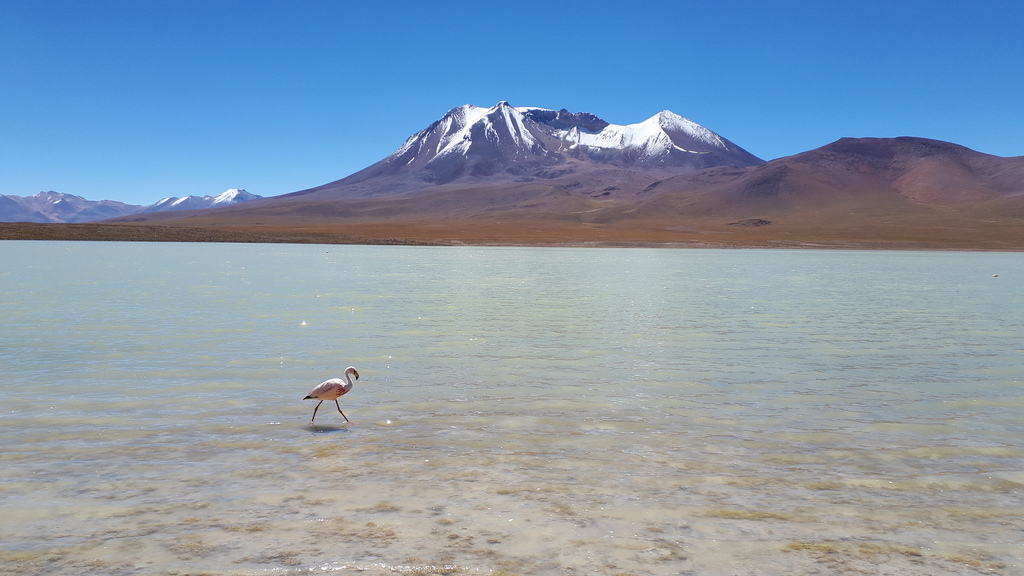
Photo: (c) Andreas Schneider, some rights reserved (CC BY) · CC-BY
Phoenicoparrus jamesi
Basic stats
Diet
Diatoms and other microscopic algae filtered from shallow lake water
Habitat
High Andean saline lakes of the altiplano; descends to lower wetlands in winter
Range
Southern Peru, western Bolivia, northern Chile and northwestern Argentina
Clutch size
1 egg
Incubation period
26–31 days
Size
About 90–92cm long
Weight
About 2kg
James's flamingo, also called the puna flamingo, is the smallest of the three Andean flamingos. Its plumage is very pale pink with bright carmine streaks on the lower neck, breast and back, and long scarlet back plumes largely cover the black flight feathers when it stands. The short, thick bill is bright yellow with a black tip, the bare skin in front of the eye is red, and the legs are brick red. The Andean flamingo is larger with yellow legs and much more black on the bill and wings, and the Chilean flamingo is pinker with a pale, not yellow, bill. Like the Andean flamingo it has no hind toe (Wikipedia, general species account).
It feeds by sweeping its upside-down head through shallow water, and has the finest filter apparatus of any flamingo, straining out diatoms and other tiny algae. Birds breed in colonies, often shared with the other two Andean flamingos. Breeding begins at about six years old and can skip years; the single egg is laid on a mud cone and both parents incubate it and feed the chick with a secretion from the crop. The species was thought to be extinct until a population was found in a remote area in 1956 (Wikipedia, general species account).
Bolivia's altiplano holds some of the most important lakes for this species. The Wikipedia account illustrates birds feeding at Laguna Hedionda in Nor Lípez, Potosí. Egg collecting for sale was a traditional practice and is now controlled, while mining and changes to lake water threaten the species' food (Wikipedia, general species account). On this guide it is a target species of the Eduardo Avaroa Andean Fauna Reserve, where Laguna Colorada is a major breeding and feeding site, of Sajama National Park and of the lagoons around the Salar de Uyuni.
Quick answers
- What does the James's Flamingo eat?
- Diatoms and other microscopic algae filtered from shallow lake water
- What habitat does the James's Flamingo live in?
- High Andean saline lakes of the altiplano; descends to lower wetlands in winter
- Where is the James's Flamingo found?
- Southern Peru, western Bolivia, northern Chile and northwestern Argentina
- How many eggs does the James's Flamingo lay?
- 1 egg
- How long are the eggs of the James's Flamingo incubated?
- 26–31 days
- How big is the James's Flamingo?
- About 90–92cm long
- How much does the James's Flamingo weigh?
- About 2kg