 Wildlife
of Bolivia
Jaguarundi
Cats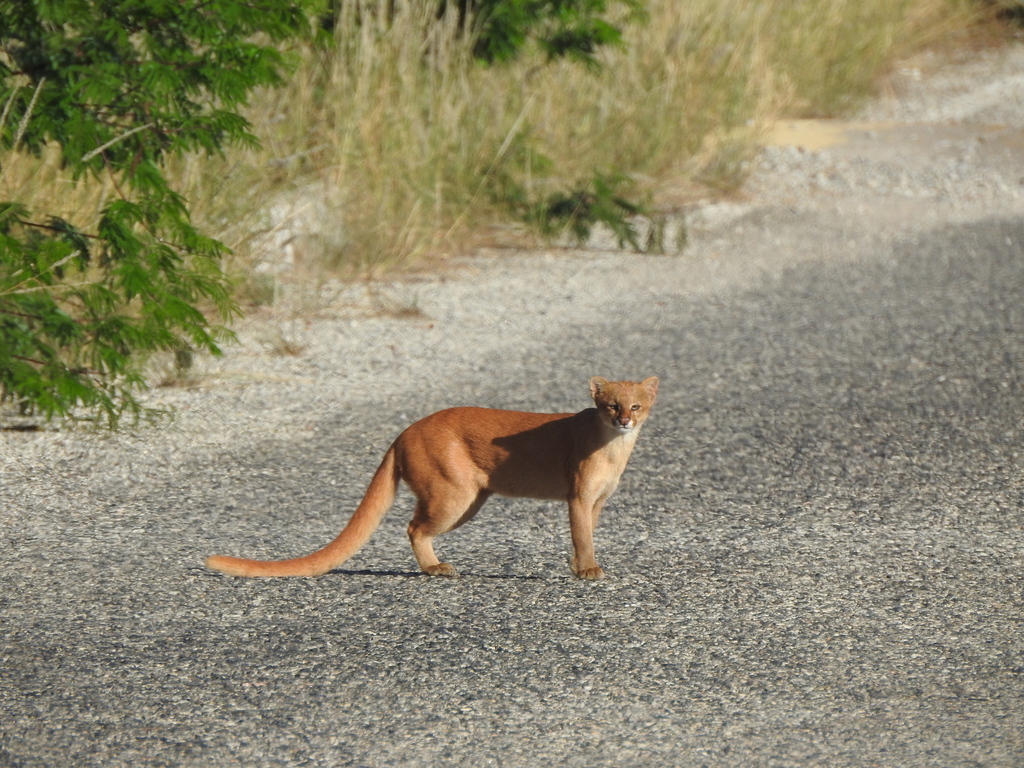
Photo: (c) Adeilson Melo, some rights reserved (CC BY) · CC-BY
Herpailurus yagouaroundi
Basic stats
Diet
Mostly small animals under about 1kg, especially rodents and ground-feeding birds; also reptiles, small mammals, opossums, fruit and arthropods
Habitat
Rainforest, deciduous forest, thorn scrub, savanna, cloud forest, mangroves and desert edges; most often in dense cover with openings and edges
Range
Central Argentina north through South America east of the Andes, Central America and into northern Mexico
Litter size
1–4, averaging about 2.3
Gestation period
70–75 days
Size
Head and body 53–77cm; tail 31–52cm
Weight
3.5–7kg; larger individuals of about 9kg reported
The jaguarundi is a slender, medium-sized cat about twice the size of a domestic cat, with an elongated body, relatively short legs, a small narrow head, small round ears, a short snout and a long tail, giving it a mustelid-like look (Wikipedia, general species account). Its coat is almost uniform, with at most faint markings on the face and belly, and kittens are spotted only briefly. Two colour forms exist, grey and red, and both can appear in the same litter. Blackish-brown individuals can resemble the tayra, but the tayra has a clear yellowish patch on its throat, while the jaguarundi has black and white marks on its lips and snout (Wikipedia, general species account).
It is secretive and alert, usually solitary or in pairs in the wild, and it keeps large home ranges across a sparsely distributed population (Wikipedia, general species account). Unlike the ocelot, which shares parts of its range, it is mainly active by day and also hunts in the evening. It is an efficient climber but prefers hunting on the ground, mostly taking small prey (Handbook of the Mammals of the World). Mating happens year-round, and after a gestation of 70–75 days a litter of one to four kittens is born; birth dens have been found in thickets, hollow trees and thick grass (Handbook of the Mammals of the World). Captive individuals have lived up to about 15 years (Wikipedia, general species account). In Bolivia one jaguarundi was recorded swimming across the Tuichi River, and hunting the species is banned there (Wikipedia, general species account).
Quick answers
- What does the Jaguarundi eat?
- Mostly small animals under about 1kg, especially rodents and ground-feeding birds; also reptiles, small mammals, opossums, fruit and arthropods
- What habitat does the Jaguarundi live in?
- Rainforest, deciduous forest, thorn scrub, savanna, cloud forest, mangroves and desert edges; most often in dense cover with openings and edges
- Where is the Jaguarundi found?
- Central Argentina north through South America east of the Andes, Central America and into northern Mexico
- What is the litter size of the Jaguarundi?
- 1–4, averaging about 2.3
- How long is the gestation period of the Jaguarundi?
- 70–75 days
- How big is the Jaguarundi?
- Head and body 53–77cm; tail 31–52cm
- How much does the Jaguarundi weigh?
- 3.5–7kg; larger individuals of about 9kg reported