 Wildlife
of Bolivia
Horned Curassow
Pheasants, Partridges & Quails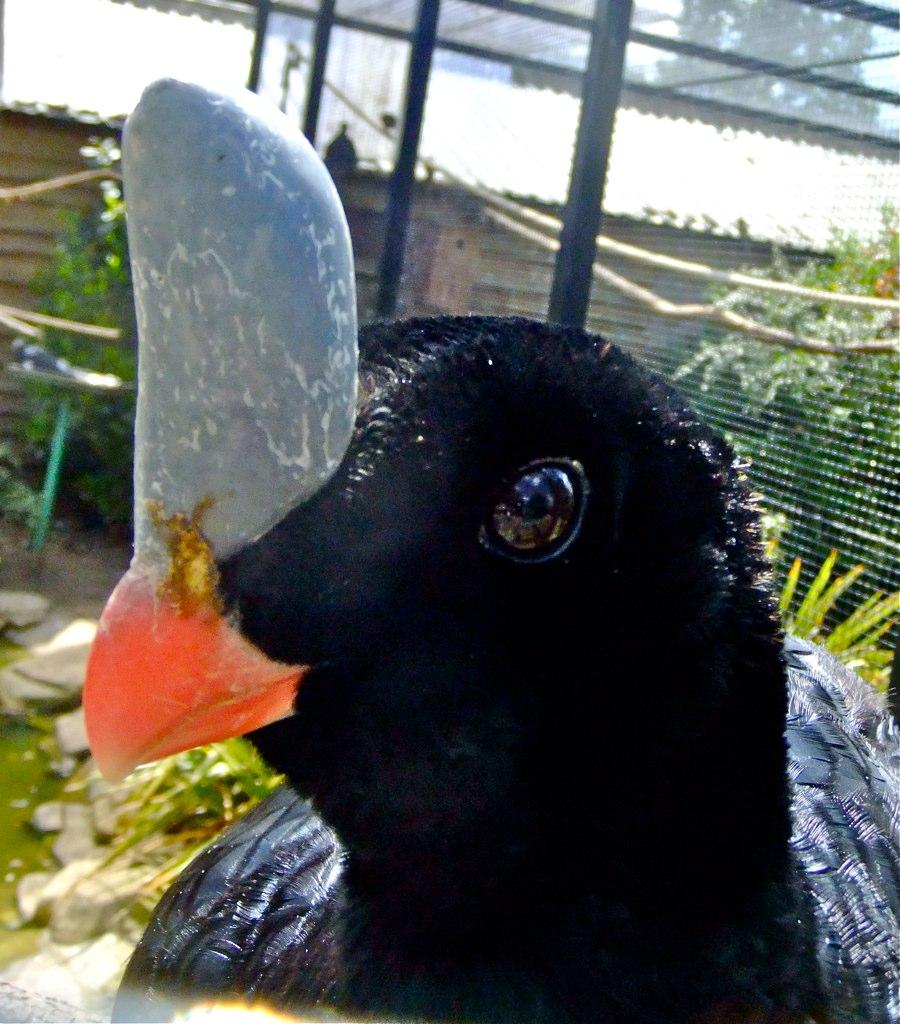
Photo: Flickr user 36917655@N08 · CC BY 2.0
Pauxi unicornis
Basic stats
Diet
Mainly seeds and fruit
Habitat
Humid tropical and subtropical forest, including a record at about 380m in Santa Cruz
Range
Endemic to Bolivia as originally described; potential habitat in central Bolivia in Amboró, Carrasco and Isiboro Sécure national parks
Size
85–95cm
Weight
Large males 3.7–3.9kg; averages about 3.7kg
The horned curassow is one of the largest cracids, 85–95cm long, and is mostly black. Its distinctive feature is a horn or casque on the forehead that projects more than 6cm. The plumage lacks a blue gloss on the primary feathers, the belly, thigh tufts and under-tail coverts are white, and the tail has white tips. Only the great curassow is heavier among cracids, and the black curassow and the closely related helmeted curassow are about the same length. Its wing chord is 38.1–40.2cm, tail 31–34.8cm and tarsus 10–10.8cm (Wikipedia, general species account). It averages about 3.7kg (AVONET, Tobias et al. 2022).
It lives in humid tropical and subtropical forest, and habitat loss is the threat named for it (Wikipedia, general species account). Its diet is mainly seeds and fruit (EltonTraits, Wilman et al. 2014). Sightings are very scarce: most documented occurrences date from 1997 to 2008, and recent reports come from the TIPNIS area in Cochabamba (Montenegro-Avila 2025). In September 2017 one bird was seen in Santa Cruz, where it climbed about 15m into a tree and performed a series of tail-wagging behaviours with vocalisations (Montenegro-Avila 2025).
The species was first described in 1939 from a specimen collected in Bolivia, and as originally described it was endemic to Bolivia (Wikipedia, general species account). Wikipedia estimates the potential habitat of the nominal subspecies at about 4000km², within the national parks of Amboró, Carrasco and Isiboro Sécure, but many parts of that area have no records, including the north-western 2000km². The 2017 sighting in Santa Cruz was 29km west of Yapacaní, at 382m (Montenegro-Avila 2025).
Quick answers
- What does the Horned Curassow eat?
- Mainly seeds and fruit
- What habitat does the Horned Curassow live in?
- Humid tropical and subtropical forest, including a record at about 380m in Santa Cruz
- Where is the Horned Curassow found?
- Endemic to Bolivia as originally described; potential habitat in central Bolivia in Amboró, Carrasco and Isiboro Sécure national parks
- How big is the Horned Curassow?
- 85–95cm
- How much does the Horned Curassow weigh?
- Large males 3.7–3.9kg; averages about 3.7kg