 Wildlife
of Bolivia
Greater Grison
Bears, Dogs & Otters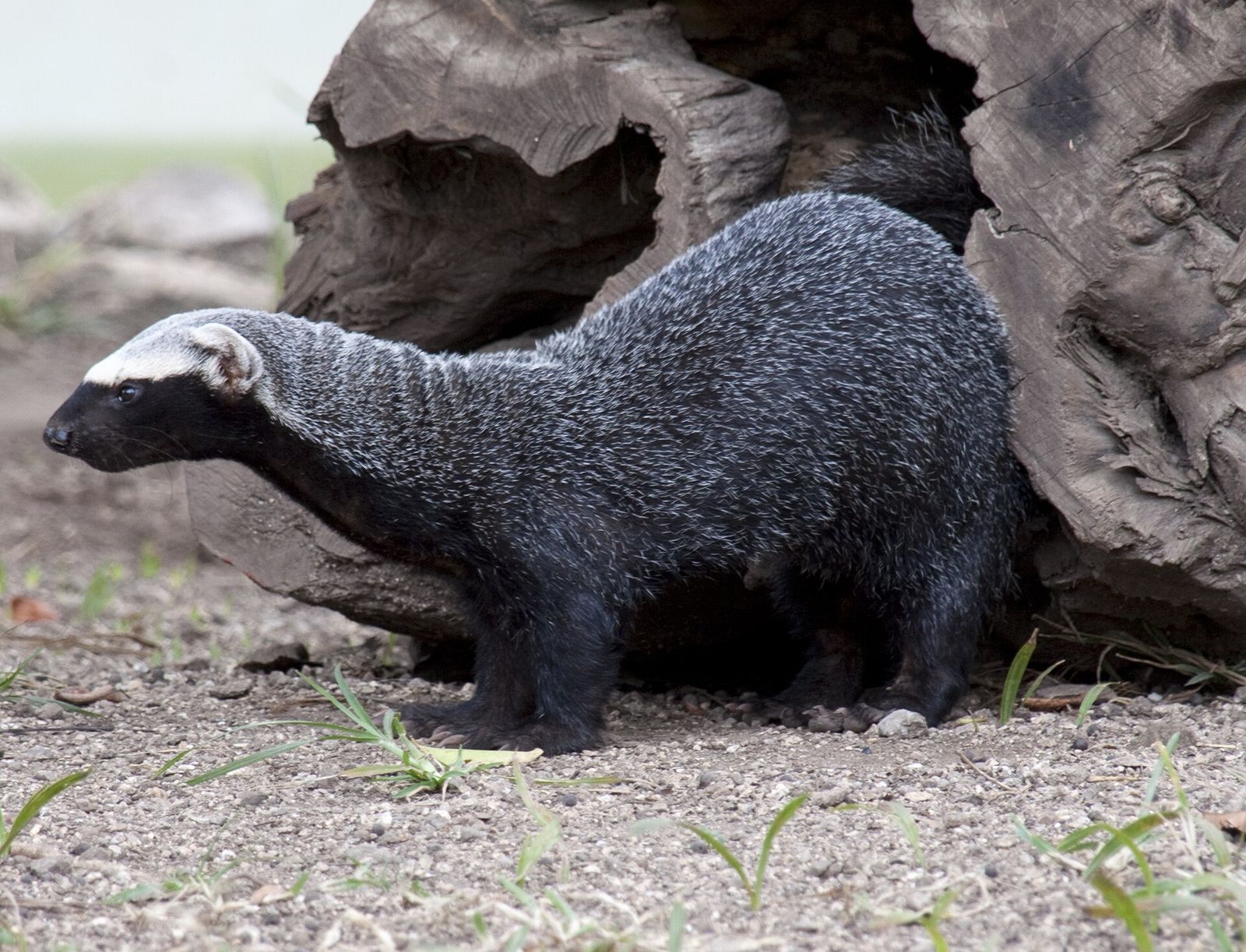
Photo: Tony Hisgett · CC BY 2.0
Galictis vittata
Basic stats
Diet
Small vertebrates such as fish, amphibians, birds and other mammals, plus eggs, reptiles, invertebrates and fruit; in north-east Brazil rock cavies are major prey
Habitat
Forest and cerrado, mostly below 500m and usually near rivers and streams; also plantations and flooded rice fields
Range
From southern Mexico to central Brazil, Peru and Bolivia
Litter size
Up to four young; about 2 on average (COMBINE, Soria et al. 2021)
Gestation period
About 39 days (Handbook of the Mammals of the World; COMBINE, Soria et al. 2021)
Size
Head and body 45–60cm; tail 14–20cm
Weight
1.5–3.8kg in the wild; about 2.3kg on average (COMBINE, Soria et al. 2021)
The greater grison is a slender, long-necked mustelid with short legs and a short, bushy tail. It is the larger of the two grisons and is best told apart from the lesser grison by its size (Wikipedia, general species account). The back, flanks, top of the head and tail are grizzled grey, while the rest of the body is much darker and usually solid black. A narrow whitish stripe runs from the forehead down the sides of the neck, separating the black face from the grey back. The head is flattened and broad, the ears short and rounded, and each of the five webbed toes ends in a sharp, curved claw (Wikipedia, general species account).
Greater grisons are mainly terrestrial but climb trees and swim well, and they are mostly diurnal. They live alone or in pairs, with home ranges of at least 4.2 km2, and at very low density they are seldom seen (Wikipedia, general species account). They sleep in hollow logs, under tree roots or in old burrows. While hunting they move in a zigzag, with short bounds and frequent stops to sniff the air, and when cautious they press close to the ground (Wikipedia, general species account). Litters of up to four are born from March to September. The young open their eyes after two weeks and reach adult size in about four months (Wikipedia, general species account).
Bolivia lies within the greater grison's range, which the Wikipedia account gives as far south as Bolivia (Wikipedia, general species account). On the east slopes of the Andes in Bolivia it ranges up to about 2,000m (Handbook of the Mammals of the World). The subspecies G. v. andina is found in Bolivia and Peru (Handbook of the Mammals of the World).
Quick answers
- What does the Greater Grison eat?
- Small vertebrates such as fish, amphibians, birds and other mammals, plus eggs, reptiles, invertebrates and fruit; in north-east Brazil rock cavies are major prey
- What habitat does the Greater Grison live in?
- Forest and cerrado, mostly below 500m and usually near rivers and streams; also plantations and flooded rice fields
- Where is the Greater Grison found?
- From southern Mexico to central Brazil, Peru and Bolivia
- What is the litter size of the Greater Grison?
- Up to four young; about 2 on average (COMBINE, Soria et al. 2021)
- How long is the gestation period of the Greater Grison?
- About 39 days (Handbook of the Mammals of the World; COMBINE, Soria et al. 2021)
- How big is the Greater Grison?
- Head and body 45–60cm; tail 14–20cm
- How much does the Greater Grison weigh?
- 1.5–3.8kg in the wild; about 2.3kg on average (COMBINE, Soria et al. 2021)