 Wildlife
of Bolivia
Culpeo
Bears, Dogs & Otters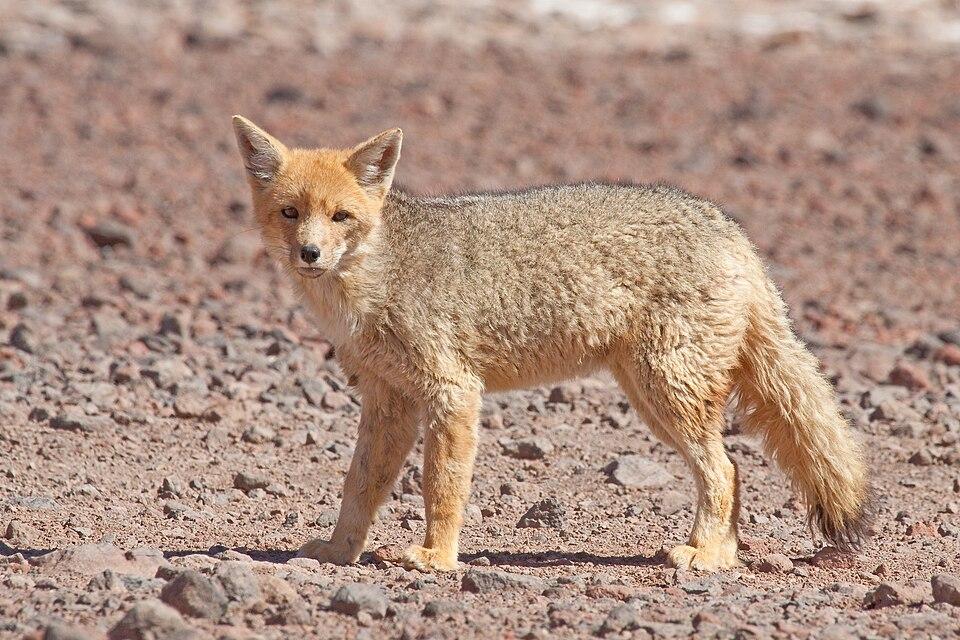
Photo: Christian Mehlführer · CC BY-SA 3.0
Lycalopex culpaeus
Basic stats
Diet
Opportunistic: mainly rodents (including degus), European rabbits and hares, with birds, lizards, insects, fruit and carrion; occasionally lambs, poultry and young guanacos
Habitat
A wide range of western South American habitats, including temperate Nothofagus rainforest, scrub, deserts, chaparral and the Altiplano, up to the tree line at about 4,800m
Range
From Patagonia and Tierra del Fuego north to Ecuador and Peru, with some populations in southern Colombia
Litter size
Usually two to five pups; about 4 on average (COMBINE, Soria et al. 2021)
Gestation period
About 61 days (AnAge); 55–60 days
Size
Total length 94–133cm, including a tail of 32–44cm
Weight
Males about 11.4kg and females about 8.4kg; overall 5–13.5kg
The culpeo is a fox-like canid that is not a true fox and is more closely related to wolves and jackals (Wikipedia, general species account). It is the second-largest native canid in South America after the maned wolf, and it sits in size between a red fox and a coyote. It is grey and reddish, with a white chin, reddish legs and a dark upper back. Its pelt is grizzled, the neck and shoulders are tawny to rufous, and the bushy tail has a black tip (Wikipedia, general species account). Its stripe along the back may be barely visible.
The culpeo is an opportunist that takes whatever prey is available. The larger culpeo appears to dominate potential competitors such as the South American grey fox, Geoffroy's cat, the pampas cat and grisons, and in Patagonia it eats more introduced European hares than the grey fox does, while the grey fox eats more rodents. In colder seasons their diets overlap more, and the culpeo uses its size to exclude the grey fox from areas with richer prey (Wikipedia, general species account). Rabbits introduced in 1915 are believed to have helped it spread from the Andean foothills onto the Patagonian plain. The typical mating period is August to October (Wikipedia, general species account).
Bolivia is included in the species' listed range (GBIF species profile), which otherwise runs from southern Patagonia to Ecuador and Peru. On this guide it is a target species of Eduardo Avaroa Andean Fauna Reserve.
Quick answers
- What does the Culpeo eat?
- Opportunistic: mainly rodents (including degus), European rabbits and hares, with birds, lizards, insects, fruit and carrion; occasionally lambs, poultry and young guanacos
- What habitat does the Culpeo live in?
- A wide range of western South American habitats, including temperate Nothofagus rainforest, scrub, deserts, chaparral and the Altiplano, up to the tree line at about 4,800m
- Where is the Culpeo found?
- From Patagonia and Tierra del Fuego north to Ecuador and Peru, with some populations in southern Colombia
- What is the litter size of the Culpeo?
- Usually two to five pups; about 4 on average (COMBINE, Soria et al. 2021)
- How long is the gestation period of the Culpeo?
- About 61 days (AnAge); 55–60 days
- How big is the Culpeo?
- Total length 94–133cm, including a tail of 32–44cm
- How much does the Culpeo weigh?
- Males about 11.4kg and females about 8.4kg; overall 5–13.5kg