 Wildlife
of Bolivia
Blue-throated Piping-Guan
Pheasants, Partridges & Quails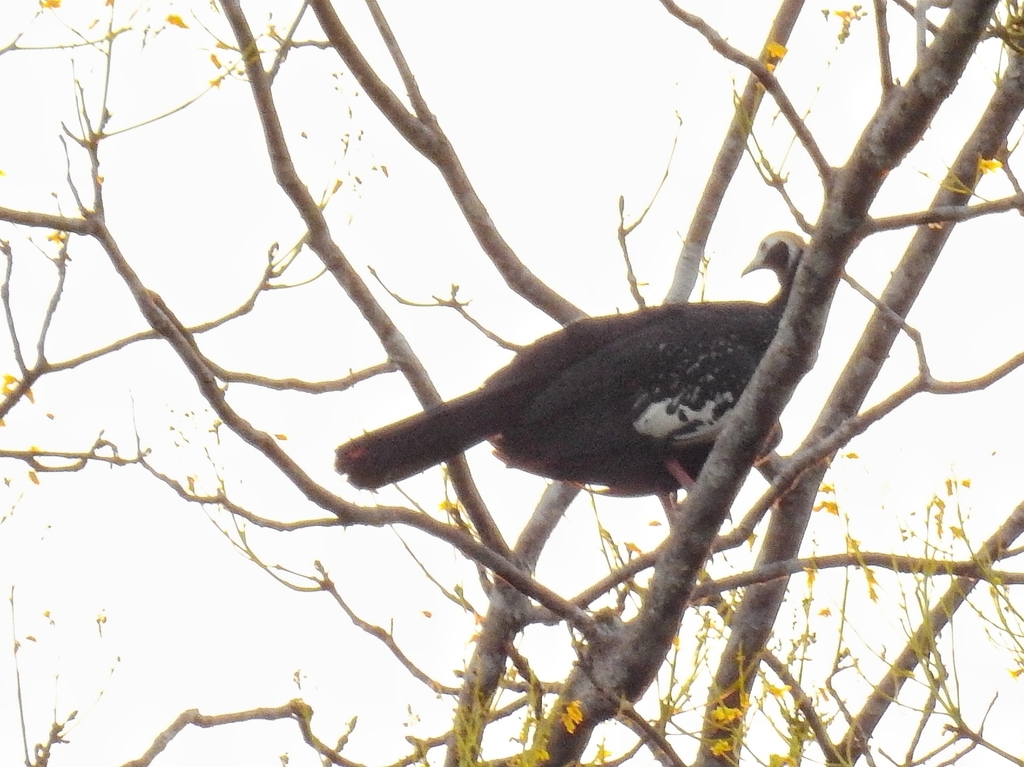
Photo: (c) Esteban Poveda, some rights reserved (CC BY) · CC-BY
Pipile cumanensis
Basic stats
Diet
Mostly fruit, especially figs, and leaves
Habitat
Humid tropical forest of the Amazon basin, including terra firme, várzea, gallery and semi-deciduous forest, almost always within about 100m of rivers
Range
Far north-west Bolivia, eastern Peru and Ecuador, central and eastern Colombia, southern and eastern Venezuela, the Guianas and north-west Brazil
Clutch size
1–3 eggs
Incubation period
24–28 days (known from captive birds)
Size
60–69cm
Weight
970–1350g; averages about 1.2kg
The blue-throated piping-guan is 60–69cm long, with a long neck and a long tail and a disproportionately thin, small head. The sexes look alike. Most of the plumage is blackish with a greenish-blue gloss that is strongest on the shoulders, wings and tail. The forehead, crown and nape are white, the outer wing coverts are white and form a large patch on the folded wing, and the inner coverts have white spots. The eye is dark reddish-brown and set in white to cobalt-blue bare skin. The bill is pale blue with a black tip, or black with a pinkish and blue base, and the legs are reddish. It weighs about 970–1350g and averages about 1.2kg (Wikipedia, general species account; AVONET, Tobias et al. 2022).
It is thought to be mostly sedentary, though it may make local or altitudinal moves as fruit becomes available (Wikipedia, general species account). Its diet is mostly fruit, especially figs, and leaves. It forages in or just below the canopy and sometimes on the ground under a fruiting tree, and it also eats earth (Wikipedia, general species account). Outside the nesting season it may gather in flocks of up to about 30 birds, especially at salt licks. The breeding season runs from August to possibly April, in the local wet season. Its twig nest, placed high in the dense canopy, holds one to three eggs, and incubation, known only from captive birds, lasts 24–28 days (Wikipedia, general species account). It is vocal mostly in the breeding season, giving a flight display of wing claps followed by slow, rising whistles at dawn and dusk. It is hunted for food and kept in captivity, and habitat destruction, mainly for agriculture, affects it in places (Wikipedia, general species account).
Quick answers
- What does the Blue-throated Piping-Guan eat?
- Mostly fruit, especially figs, and leaves
- What habitat does the Blue-throated Piping-Guan live in?
- Humid tropical forest of the Amazon basin, including terra firme, várzea, gallery and semi-deciduous forest, almost always within about 100m of rivers
- Where is the Blue-throated Piping-Guan found?
- Far north-west Bolivia, eastern Peru and Ecuador, central and eastern Colombia, southern and eastern Venezuela, the Guianas and north-west Brazil
- How many eggs does the Blue-throated Piping-Guan lay?
- 1–3 eggs
- How long are the eggs of the Blue-throated Piping-Guan incubated?
- 24–28 days (known from captive birds)
- How big is the Blue-throated Piping-Guan?
- 60–69cm
- How much does the Blue-throated Piping-Guan weigh?
- 970–1350g; averages about 1.2kg